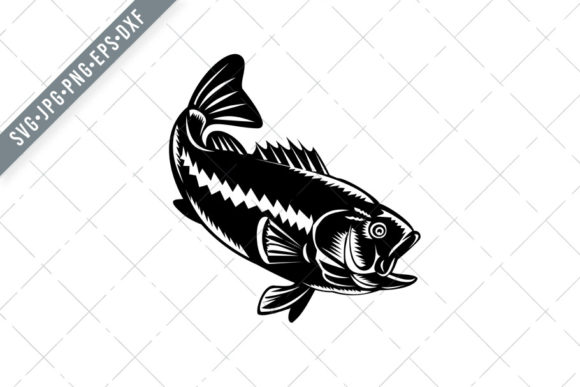
The Largemouth Bass Diving Down: A Retro Woodcut Illustration for Modern Crafting
There is something timeless about the image of a largemouth bass suspended in clear water, its body curved as it dives downward in a burst of energy. For anglers, naturalists, and fishing enthusiasts, this iconic freshwater gamefish represents more than just a prized catch—it embodies the wild spirit of North American lakes and rivers. Now, a growing trend in the crafting and design world is bringing that spirit to life through retro woodcut black and white illustrations of the largemouth bass, specifically the species Micropterus salmoides. These illustrations capture the power and grace of the fish in a vintage style that pairs beautifully with modern digital crafting tools like SVG files for Cricut and Silhouette machines. In this article, we explore everything from the biology of the bass to the practical uses of these design files, helping you understand how to bring nature-inspired art into your everyday projects.
Understanding the Largemouth Bass: A Carnivorous Freshwater Gamefish
The largemouth bass (Micropterus salmoides) is a species of black bass native to eastern North America but now introduced to waters around the world. As a carnivorous freshwater gamefish, it occupies the top of the food chain in many aquatic ecosystems, feeding on smaller fish, crayfish, frogs, and even small birds or mammals that venture too close to the water's surface. Its name comes from the distinctive feature of its jaw: the upper jaw extends well beyond the eye, allowing it to swallow prey nearly half its own size.
When a largemouth bass dives down, it is often either hunting or evading a predator. The diving motion is a powerful, controlled movement that uses the fish's broad tail and strong musculature to propel it downward with surprising speed. This behavior is particularly common when the bass is targeting prey lurking near the bottom or when it is startled by a boat or angler. Understanding this natural action helps illustrators and designers capture the fish in a dynamic, realistic pose—one that suggests motion, tension, and the raw energy of the wild.
The Appeal of the Diving Pose in Art
Artists have long been drawn to the diving pose of fish because it conveys a story. Unlike a static side-view illustration, a diving bass suggests action and intent. The viewer can imagine the fish just before it strikes, or perhaps as it retreats to deeper water. In retro woodcut black and white style, this dynamic pose becomes even more striking. The high-contrast lines and bold shapes mimic the look of vintage naturalist engravings from the 19th and early 20th centuries, giving the artwork a timeless, collectible feel.
The Retro Woodcut Style: Why Black and White Works
Woodcut illustration is one of the oldest methods of printmaking, dating back centuries. In a woodcut, an artist carves an image into a block of wood, then inks the raised surfaces and presses them onto paper. The result is a bold, high-contrast image with strong lines and minimal shading. Modern digital recreations of this style retain those same visual qualities: crisp edges, dramatic black-and-white contrast, and a slightly rough, handcrafted texture that mass-produced digital images often lack.
For a largemouth bass illustration, the retro woodcut approach works particularly well. The fish's scales, fins, and jawline can be rendered with clean, deliberate cuts that mimic the chisel marks of a woodblock. The black background or heavy black areas emphasize the white fish shape, making the image pop. This style is also highly scalable, meaning it looks good whether printed on a small sticker or a large wall poster.
Many crafters and designers gravitate toward black and white woodcut-style graphics because they are versatile. They can be used on any color background, layered with other elements, or printed with minimal ink. The retro aesthetic also evokes a sense of nostalgia and authenticity, appealing to those who love vintage fishing gear, classic outdoorsman culture, or natural history illustration.
What’s Inside the Digital Design Set
If you are a crafter, designer, or DIY enthusiast, you’ve probably encountered digital design sets that include multiple file formats. The typical download for a largemouth bass diving down illustration includes a ZIP folder containing the following files:
- SVG vector file – Scalable and editable, perfect for use with Silhouette Studio Cameo, Cricut Design Space, and other cutting machine software.
- PNG file – 300 dpi resolution, at least 10 inches in size, ideal for print projects, web use, or digital scrapbooking.
- DXF file – A CAD-compatible vector format that works with many cutting machines and design applications.
- EPS file – A versatile vector format that opens in Adobe Illustrator, CorelDRAW, and most professional design tools.
- JPG file – A high-quality raster image for quick previewing or simple printing.
Having a variety of file types ensures that you can use the design no matter what software or machine you own. Whether you are cutting vinyl for a T-shirt, engraving a mug, printing a greeting card, or creating a stencil for wall art, one of these formats will meet your needs.
Why SVG and Vector Files Matter for Crafting
Vector files (like SVG and EPS) are resolution-independent, meaning they can be scaled up or down without losing quality. This is critical when you want to create a large wall decal or a tiny sticker from the same design. The SVG format, in particular, has become the industry standard for cutting machines because it preserves the paths and curves that the machine needs to cut accurately. With a well-made SVG of a diving largemouth bass, you can expect clean, crisp cuts along every fin and scale.
The PNG file, on the other hand, is a raster image with a transparent background (if saved with transparency), making it easy to drop into digital layouts or print directly. The 300 dpi resolution ensures sharp output even at 10 inches or larger, so your prints look professional and detailed.
Practical Projects for Your Largemouth Bass Illustration
Once you have the design files in hand, the possibilities are nearly endless. Here are some of the most popular ways crafters and hobbyists use this type of artwork:
- T-shirts and apparel – Use the SVG or DXF file to cut heat-transfer vinyl, then iron it onto a shirt, hoodie, or hat. The bold black-and-white design works especially well on light or dark fabrics.
- Mugs and drinkware – Create a custom mug using sublimation or permanent vinyl. A diving bass on a coffee mug makes a great gift for an angler.
- Stencils – Cut the design from adhesive vinyl or mylar, then use it to paint onto wood, canvas, or walls.
- Wall art – Print the JPG or PNG file at a large size and frame it, or use the SVG to create a layered wood sign with the bass as the centerpiece.
- Greeting cards and invitations – The retro woodcut style lends itself beautifully to birthday cards, fishing party invites, or thank-you notes with an outdoor theme.
- Scrapbooking – Use the PNG file (with its transparent background) to add a dramatic element to scrapbook pages about fishing trips or nature outings.
- Stickers and decals – Cut adhesive vinyl or print onto sticker paper for laptops, coolers, water bottles, or truck windows.
- Patterns and fabric design – Use the EPS or SVG file to create repeating patterns for fabric, wrapping paper, or digital backgrounds.
The beauty of having the illustration in multiple formats is that you can use the same bass design across different mediums without having to recreate it from scratch. A single purchase or download can fuel dozens of creative projects.
Common Misunderstandings About Digital Design Files
If you are new to digital crafting, you may hear some confusion about what these files can and cannot do. Let's clarify a few points:
- "I need a PNG with a white background." Actually, a PNG with a transparent background is more versatile, because you can place it on any color without a white box around it. Most design sets provide transparent PNGs.
- "SVG files only work on Cricut." Not true. SVG is a universal vector format that works in many programs and machines, including Silhouette Studio, Brother ScanNCut, and even web browsers.
- "The file size is too small to print large." Vector files (SVG, EPS, DXF) can be scaled to any size without quality loss. The PNG and JPG are provided at 300 dpi and at least 10 inches, which is enough for most large-format prints.
- "I can't use DXF files." DXF is an older format but still widely supported in design software and cutting machines. If your program can't open DXF, try the SVG or EPS instead.
Why This Combination of Nature and Woodcut Style Resonates Today
In an age of hyper-realistic digital graphics and AI-generated imagery, the retro woodcut style stands out because it feels human and intentional. It harkens back to a time when illustrations were carved by hand, and each line had a purpose. When that style is applied to a largemouth bass diving down, the result is both educational and artistic. It invites viewers to appreciate the fish not just as a species, but as a symbol of the outdoors, of patience and the thrill of the catch.
For modern creators, using these files is a way to bridge the analog and digital worlds. You can start with a vintage-inspired design on your computer, cut it with a precision machine, and end up with a physical object—a shirt, a mug, a sign—that feels personal and handcrafted. It's also a wonderful way to introduce younger generations to the beauty of nature and the history of illustration.
Tips for Getting the Best Results
To make the most of your largemouth bass design set, keep these tips in mind:
- Always use a fresh blade in your cutting machine when working with detailed vector files. A dull blade can miss fine lines on fins or scales.
- When using the PNG file for printing, make sure your printer is set to the highest quality and that you are using paper or vinyl compatible with your printer type (inkjet or laser).
- If you plan to engrave the design onto wood or metal, use the SVG or DXF file in your laser engraving software. The high contrast of the woodcut style translates beautifully into engraved lines.
- Consider layering the design with other vintage elements—such as a compass, map coordinates, or a rod and reel—to create a more complex composition.
Conclusion: A Design That Keeps on Giving
Whether you are an experienced crafter looking for a fresh project or a fishing enthusiast wanting to decorate your space with a meaningful image, the largemouth bass diving down in retro woodcut style offers something special. It combines a deep appreciation for one of nature's most remarkable gamefish with a classic artistic style that never goes out of fashion. And with a full set of file types—SVG, PNG, DXF, EPS, and JPG—you have the flexibility to use it across countless projects, from T-shirts to wall art to party invites.
So go ahead: download the set, fire up your cutting machine, and bring the powerhouse of freshwater lakes into your home, your wardrobe, and your creative portfolio. The bass is diving—are you ready to catch the inspiration?