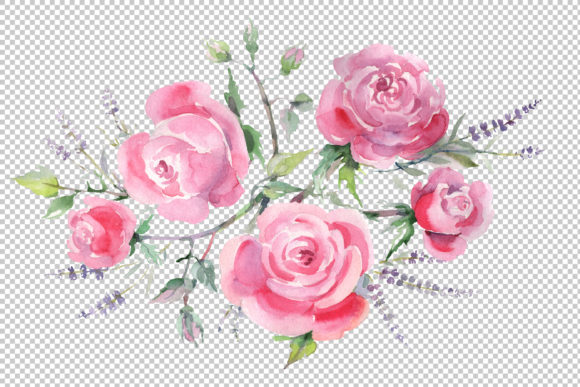
Bouquet with Roses and Lavender Pink Watercolor: A Versatile Asset for Creative Workflows
Digital design assets often fall into two categories: those that demand extensive editing before they become useful, and those that are ready to drop into a project and elevate it immediately. The Bouquet with Roses and Lavender Pink Watercolor set belongs firmly in the latter group. This hand-painted collection of watercolor elements—featuring roses, lavender, soft pink tones, and accompanying frames, borders, and patterns—offers a practical foundation for a wide range of creative and professional work. Understanding what this resource is, how it fits into real workflows, and how to integrate it efficiently can save hours of production time while improving the visual consistency of your output.
What the Bouquet with Roses and Lavender Pink Watercolor Set Contains
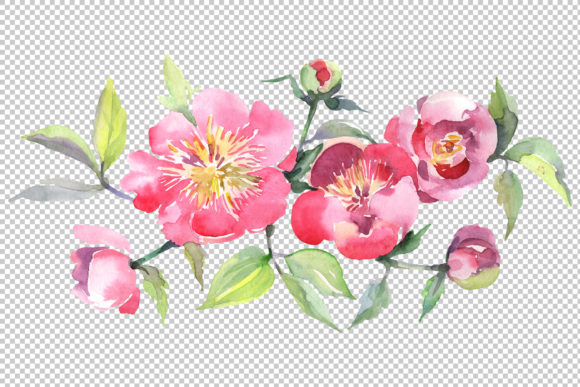
This pack delivers one PNG file of a watercolor bouquet illustration, supplemented by additional elements such as frames, borders, patterns, and isolated botanical details. All illustrations are highly detailed, hand-painted, and provided at 300 dpi with transparent backgrounds. The frames and patterns are supplied as JPG files at 3500x3500 pixels, which gives you ample resolution for both digital and print applications. Because the graphics are separate files with transparent backgrounds, you can layer them into existing designs without fighting with white boxes or awkward cropping. The watercolor aesthetic—soft edges, graduated washes, and natural pigment variation—brings a tactile, handmade feel that is difficult to replicate with vector tools alone.
Where This Watercolor Bouquet Fits in a Creative Workflow
Every creative project follows a cycle: planning, asset gathering, composition, refinement, and output. The Bouquet with Roses and Lavender Pink Watercolor set is most useful during the asset gathering and composition phases, but its value ripples across the entire process.
Before the Project: Preparation and Planning
If you are mapping out a wedding invitation suite, a greeting card line, or a series of social media posts, having a clear visual direction early reduces decision fatigue later. The pink watercolor palette of roses and lavender gives you a concrete reference point. You can pull the dominant pink, soft green, and delicate lavender tones directly from the artwork to build a color palette, typography scheme, and paper selection before you start laying out pages. This avoids the common trap of designing around a weak placeholder image and then struggling to find a final asset that matches.
During the Project: Composition and Integration
This is where the set earns its keep. The isolated PNG files allow you to place the bouquet precisely within a layout—centered on a save-the-date card, off to one side on a thank-you note, or as a repeating pattern on envelope liners. Because the background is transparent and the resolution is 300 dpi, scaling and positioning are straightforward in most design software. The frames and borders can be used to structure content areas, while the isolated elements let you rearrange individual flowers or sprigs to suit asymmetrical layouts. If you need a background texture, the watercolor washes in the pattern files diffuse nicely behind text without overwhelming readability.
After the Project: Refinement and Output
During the refinement stage, the natural variation in the hand-painted artwork can actually work to your advantage. Unlike flat digital graphics, watercolor elements have subtle imperfections—slight color shifts, soft edges, and organic shapes. These characteristics make the final design feel less mechanical and more personal. If you need to adjust colors or sizes, the editable nature of the files (depending on your software) gives you control without requiring a full redraw. For print output, the 3500x3500 px resolution ensures that frames and patterns hold up at standard print sizes, and the 300 dpi PNG delivers clean edges for the bouquet itself.
Practical Applications Across Common Use Cases
The set is marketed for DIY, wedding invitations, greeting cards, quotes, blogs, posters, and more. Here is how each use case benefits from a workflow perspective.
Wedding Invitations and Stationery
Wedding stationery is notoriously detail-heavy. You need a cohesive look across save-the-dates, invitations, RSVP cards, thank-you notes, and sometimes even signage. Having a single watercolor bouquet set that you can reuse across all pieces—changing layout but maintaining visual consistency—saves you from hunting for matching assets for each item. The border files are particularly useful for framing text blocks without adding clutter. The lavender and pink palette also aligns well with spring and summer wedding themes, rustic-chic aesthetics, and botanical motifs.
Greeting Cards and Stationery Products
If you produce greeting cards for sale, consistency across a product line matters. One bouquet can anchor an entire collection: use the full composition for the card front, an isolated flower for the interior flap, and a pattern for the envelope interior. This creates a recognisable brand signature without requiring a dozen different illustration sets. The 300 dpi resolution also means your cards will reproduce cleanly whether you print at home, use a local print shop, or go through a commercial printer.
Blog Graphics and Social Media Content
Bloggers and content creators often need to produce visually consistent headers, quote graphics, and featured images quickly. The transparent PNG bouquet can be placed on branded background colors, overlaid with text, and exported in minutes. The pattern files work well as subtle blog post backgrounds or Pinterest pin backdrops. Because the watercolor style is soft and feminine, it suits lifestyle, wellness, wedding planning, and home decor niches particularly well. The key advantage here is speed: you do not need to commission custom artwork or spend hours painting your own elements.
Posters and Wall Art
For printable wall art, the 3500x3500 px JPG frames and patterns provide enough resolution for 12x12 inch prints and larger. The bouquet itself can be used as the central focal point in a minimalist poster, surrounded by ample negative space and a single quote. If you sell digital downloads, this set gives you a flexible foundation that can be recoloured, cropped, or layered to produce multiple variations from one source file.
DIY and Educational Materials
Teachers, workshop leaders, and DIY hobbyists can use the isolated elements to create worksheets, project templates, or craft instructions. The transparent background makes it easy to place flowers into educational infographics or class handouts without disrupting the layout. The hand-painted quality also lends a warm, approachable feel to materials that might otherwise look too clinical.
Integrating with Other Tools, Platforms, and Methods
No asset exists in isolation. How this watercolor bouquet set interacts with your existing toolkit determines whether it becomes a time-saver or a shelf-ware. Here are practical integration points.
Design Software Compatibility
The PNG format with transparent background works in virtually any raster or hybrid design tool: Adobe Photoshop, Illustrator, Affinity Photo, Canva, Procreate, GIMP, and even Microsoft PowerPoint or Keynote for quick layouts. The JPG frames and patterns are equally universal. If you use Canva for rapid social media creation, the transparent PNG can be uploaded as an element and reused across multiple designs. For print-focused workflows in Adobe InDesign, the high-resolution files hold up well in placed-linked workflows.
Layering with Typography and Other Graphics
Because the bouquet is hand-painted, it pairs well with both serif and script typefaces. The organic edges contrast nicely with clean sans-serif fonts for a modern-rustic look. If you combine this set with other watercolour elements from different packs, check that the colour temperatures and paper textures are compatible. The pink and lavender palette is relatively neutral, so it blends with muted greens, cream, gold, and dusty blue without clashing.
Print Production Considerations
For commercial printing, the 300 dpi resolution meets industry standards, but you should still check colour profiles. Watercolour scans often have subtle colour shifts compared to screen display. Request a proof before a large print run, or test on your own printer if producing at home. The transparent background is especially helpful for print-on-demand services that require clean separation between design and substrate.
Practical Tips for Efficient Use
Based on working with watercolour assets across multiple projects, here are specific practices that reduce friction and improve consistency.
- Organise by element type – Store the isolated bouquet, frames, borders, and patterns in clearly named folders. This prevents you from digging through dozens of files when you need a specific border mid-project.
- Create a master colour swatch – Use an eyedropper tool to pull the key pink, lavender, and green tones from the artwork. Save these as a swatch library in your design software so every element you add matches without guesswork.
- Reuse across a series – If you are producing a set of invitation suites or a card collection, use the same bouquet in different sizes, rotations, and crops. This builds a cohesive brand identity without requiring new assets for each item.
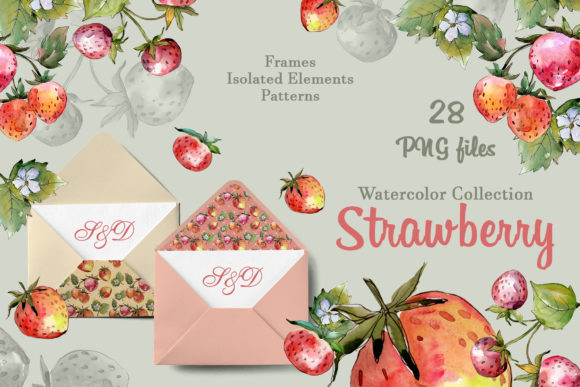
- Apply to mockups – Place the bouquet or pattern into product mockups (envelopes, framed prints, tablet screens) to preview how the final piece will look before you commit to printing. This catches layout issues early.
- Retain the original files – Always keep the untouched PNG and JPG files in a backup folder. Many users over-edit the originals and then cannot revert. If you need variations, duplicate the file first and edit the copy.
Quality Control and Consistency Considerations
Watercolour assets bring natural variation, which is both a strength and a potential consistency challenge. When using multiple elements from the set across a single layout, check that the saturation levels and paper grain are uniform. Sometimes one scan may appear slightly warmer or cooler than another under certain lighting. A quick adjustment layer in Photoshop or a filter in Canva can bring everything into alignment. For long-term use, note that watercolour scans can degrade slightly if repeatedly re-saved as low-resolution JPEGs. Always export your final designs at high resolution and archive the source files as PNG or TIFF.
Long-Term Usability and Scalability
One of the underappreciated aspects of a well-made watercolour asset set is its longevity. Unlike trendy graphic styles that date quickly, hand-painted botanical motifs have enduring appeal. The Bouquet with Roses and Lavender Pink Watercolor set can serve as a foundational resource for years—used across seasonal promotions, annual stationery updates, and new product launches. Because the files are editable in size and colour, you can adapt them to emerging trends (for example, desaturating the pink for a muted look, or boosting contrast for a more vibrant output) without losing the original hand-painted quality.
For small business owners and freelancers who produce consistent content, this type of asset reduces the cost and time of commissioning new illustrations for every project. One thoughtful purchase, properly organised and integrated into your workflow, can support dozens of unique designs across multiple product lines. The key is to treat the set not as a one-off graphic, but as a flexible component within a broader creative system.
Whether you are designing wedding invitations for a client, building a collection of printable wall art, or producing weekly blog graphics, the Bouquet with Roses and Lavender Pink Watercolor set delivers a practical, visually appealing foundation. Its hand-painted detail, transparent format, and high resolution remove technical barriers and let you focus on composition, messaging, and meeting your deadlines. With thoughtful preparation and consistent application, it becomes a reliable part of your workflow rather than just another file in your downloads folder.